
How to Record Fridge Temperatures in a Small Food Business
Last Updated: November 2, 2026
Quick Summary
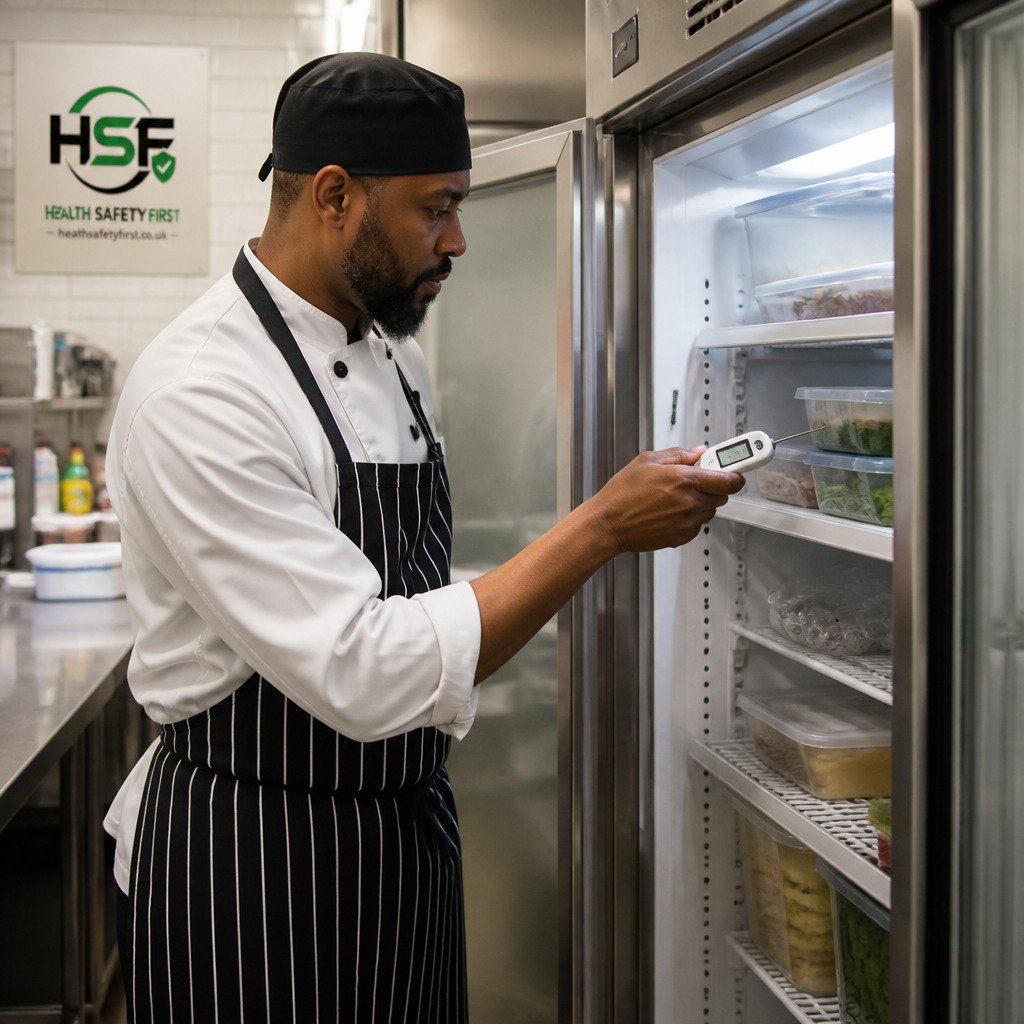
Record fridge temperatures by checking each unit at opening and closing, using a calibrated probe thermometer placed in the middle of the unit. Write the reading, time, unit, initials and any action taken on a log sheet at the moment you take it. Most chilled food should be kept at 8°C or below.
- Most chilled food should be kept at 8°C or below, with 5°C or below a good target
- Freezers should be kept at -18°C or below
- Take readings at opening and closing, plus extra checks during busy periods
- Write each reading at the time you take it, never after the fact
- Re-check and probe the food before moving anything if a fridge reads too warm
Table of Contents
- Why Recording Fridge Temperatures Matters for Food Safety
- Safe Fridge Temperature Limits to Work To
- How Often to Check Fridge Temperature in Your Business
- Step-by-Step: Taking and Recording Each Reading
- Building a Fridge and Freezer Temperature Record Template
- Fridge Temperature Log Sheet: What Every Entry Must Include
- What to Do if a Fridge Is Too Warm
- Setting Up Your Recording Routine and Keeping Records for Inspection
- Frequently Asked Questions
Why Recording Fridge Temperatures Matters for Food Safety
Recording fridge temperatures is one of the simplest ways a food business can show it is keeping food safe. A written record proves that you checked your fridges, what they read, and what you did when a reading looked wrong. For a wider view of how these checks fit into a complete plan, see how to write a food safety plan that passes inspection.
Food safety rules in the UK expect businesses to control temperature. Chilled food that gets too warm can let harmful bacteria grow, even when the food looks and smells fine. A simple log turns that expectation into a routine you can follow every day.
The record also helps you spot problems early. A fridge that slowly drifts upwards over a week is easier to fix than one that fails overnight.
- A record shows your checks actually happened
- It helps you spot slow drift before food is at risk
- It gives you clear evidence if an environmental health officer visits
- It helps your staff understand what "safe" looks like
Watch out: A log filled in after the fact, with neat readings for every check, undermines trust with an inspector. Write each reading at the time you take it.
Safe Fridge Temperature Limits to Work To
Most chilled food should be kept at 8°C or below. Many small businesses aim for a lower target to leave a safety margin, because fridges can run a little warm when the door is opened often.
Check the manufacturer's guidance for your specific equipment, as some units are rated differently.
Set a target range for each unit and write it on the log sheet. Staff should know at a glance what a good reading looks like.
- Chilled fridges: 8°C or below (aim for 5°C or below)
- Freezers: -18°C or below
- Display units: check the manufacturer's rating for that unit
How Often to Check Fridge Temperature in Your Business
Many small food businesses check fridge temperatures at opening and closing. Busy kitchens, or those with a lot of door openings, may need more frequent checks.
The right frequency depends on how your business runs. A café that only stores milk and cakes may need fewer checks than a kitchen preparing cooked meals across a long day.
Write your check times on the log so the routine is clear. Staff should not have to guess when the next reading is due.
- Opening check: first thing, before service starts
- Closing check: last thing, before you leave
- Extra checks: during busy periods or after a fault
Step-by-Step: Taking and Recording Each Reading
A reliable record starts with a good reading. Follow these steps every time you check.
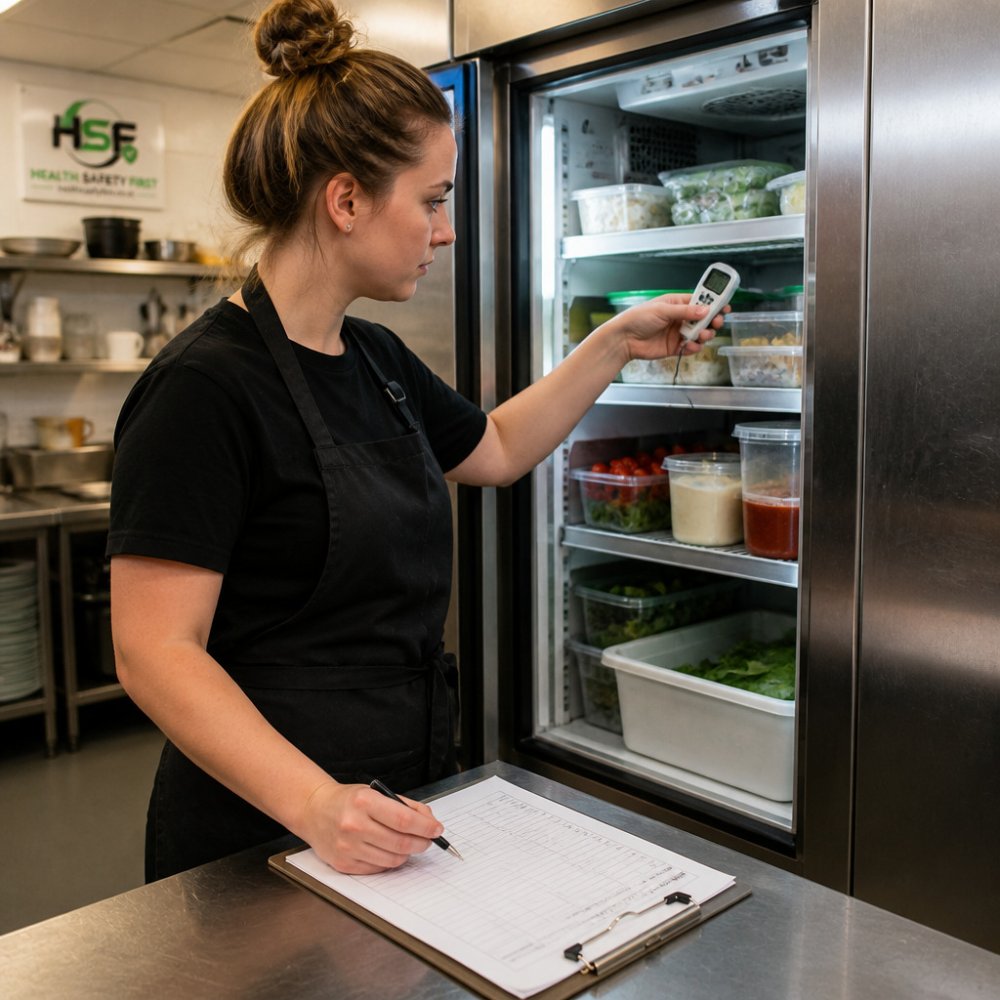
- Wipe the thermometer probe clean and check it is switched on.
- Open the fridge door only as long as you need to.
- Place the probe in the middle of the unit, away from the door and fan.
- Wait until the reading settles, then note it down.
- Write the time, date, unit name and your initials on the log.
- If the reading is outside your target, act straight away and record what you did.
A common mistake is reading the temperature of the air near the door, which can be warmer than the food inside. Take the reading from a position that reflects the food itself.
Choosing and checking your thermometer
Your record is only as good as your thermometer. Use a probe thermometer that is clearly marked with its measuring range.
Check your thermometer regularly against a known reference, such as an ice-water mix, which should read close to 0°C. If it reads well off, replace it or get it recalibrated. Keep a note of when you last checked it.
Building a Fridge and Freezer Temperature Record Template
A good template is simple enough to fill in quickly during a busy shift. Use one sheet per week or per month, with a row for each check.
Include a column for each unit, so one glance shows the whole kitchen. Leave space for corrective action notes.
- Date and time of each check
- Unit name or number
- Temperature reading
- Target range for that unit
- Initials of the person checking
- Corrective action taken, if any
Fridge Temperature Log Sheet: What Every Entry Must Include
Every entry should be complete and easy to read. Missing details make a log hard to trust.
Each row should show the date, time, unit, reading, initials and any action taken. Write clearly, and avoid leaving boxes blank.
- Date and time: when the reading was taken
- Unit: which fridge, freezer or display unit
- Reading: the exact temperature, not "OK"
- Initials: who took the reading
- Action: what you did if the reading was out of range
What to Do if a Fridge Is Too Warm
An out-of-range reading is not automatically a food safety incident, but it does require a clear, recorded response. If the fault points to a premises problem, you may also want to check fire risk assessment requirements.
1. Re-check before you move anything. Open the door, confirm the thermometer is working, and take a second reading from the same position after two to three minutes.
2. Assess the food, not just the air. If the unit is still above range, check the food itself with a probe thermometer. Place the probe between packs or into the thickest part of a high-risk item such as cooked meat, dairy or prepared salads.
3. Decide whether to move the food. If the food is above 8°C, move high-risk items to a working unit straight away. Keep a note of what was moved, when, and where it went.
4. Use time and temperature together. The longer food sits above 8°C, the greater the risk.
5. Fix the obvious causes. Check the door seal, confirm the unit is not overloaded, make sure the thermostat is set correctly, and clear any blockage around the fan or vents.
6. Escalate if the unit will not recover. If the fridge cannot be brought back into range within a reasonable period, call an engineer and record the fault in the log.
7. Record everything as it happens. Your log should show the original reading, the re-check, the food temperature if taken, the action taken, and the outcome. An inspector is looking for evidence that you recognised the problem and responded proportionately, not that every reading was perfect.
- Re-check the reading before moving food
- Probe the food itself if the air is warm
- Move high-risk items if food is above 8°C
- Use time and temperature together to decide whether food is safe
- Fix seals, loading and ventilation before calling an engineer
- Record the fault, the action and the outcome
The steps below set out how to respond when a fridge reads above its target range, in the order to follow.
| Step | What to do | Time or limit |
|---|---|---|
| Re-check the reading | Open the door, confirm the thermometer works, take a second reading | After 2 to 3 minutes |
| Probe the food | Place the probe between packs or in the thickest part | Check high-risk items first |
| Move high-risk food | Move items to a working unit and note where they went | If food is above 8°C |
| Monitor if still in range | Re-check and record each reading | Every 30 minutes |
| Fix obvious causes | Check seals, loading, thermostat and ventilation | Before calling an engineer |
| Escalate the fault | Call an engineer and record the call and temporary arrangements | If the unit will not recover |
Setting Up Your Recording Routine and Keeping Records for Inspection
A recording routine only works if it fits the way your business actually runs. The following approach is designed for small teams where one person may open, another may close, and nobody has spare time for paperwork.
Assign responsibility by shift, not by name alone. Write the name of the person responsible for checks at each shift on the log sheet itself. If that person is off, the next person on shift takes over.
Keep the log where the checks happen. A clipboard hanging near the fridges, or a tablet mounted on the wall, is more likely to be used than a folder in an office.
Train every person who records a reading. Training should cover how to take a reading, what the target range is, what to do if a reading is out of range, and how to record it. A short session at induction, plus a refresher when the log changes, is usually enough.
Review the log weekly. Look for patterns rather than individual readings. A fridge that drifts warmer every afternoon may need its thermostat checked. A gap in the log on a particular shift may mean the routine is not working. Note any actions you take as a result of the review.
Retain records for a sensible period. Keep temperature logs for a period that your food safety management system or local authority expects, so that a consistent history can be shown during an inspection. Store completed logs in a labelled folder by month, or in a dated digital folder.
Be ready for an inspection. An environmental health officer may ask to see your temperature records during a routine inspection or following a complaint. Keep the last few months of logs easily accessible, and know how to retrieve older records if needed.
- Name a responsible person for each shift on the log
- Keep the log where the checks happen
- Train everyone who records a reading
- Review weekly for patterns, not just individual readings
- Retain logs for the period your food safety system or local authority expects
- Make sure records can be retrieved quickly during an inspection
Frequently Asked Questions
How many times should the temperature inside a fridge be monitored in a small food business?
Most small food businesses check each fridge at least twice a day, once at opening and once at closing, and record both readings. Higher-risk units, such as those holding cooked meats, dairy desserts or prepared salads, may need more frequent checks during busy service. The right frequency is the one your own food safety management system sets out and that you can keep to every day. Whatever you choose, write it down in your procedures so staff know exactly when each check is due.
What should a fridge temperature log sheet include?
A useful fridge temperature log sheet records the date and time of each reading, the unit identification (for example, Fridge 2 or Display Cabinet), the temperature reading itself, and the initials or signature of the staff member who took it. Add a column for any corrective action taken and a final space for a supervisor to review the sheet. Keeping these details consistent makes it far easier to spot trends and to show an inspector a complete, credible record.
What should you do if a fridge is outside its safe temperature range?
Note the out-of-range reading on your log, check the thermostat setting and that the door seals properly, and make sure the unit is not overloaded or blocked by stock. Move high-risk food to a working unit where possible and recheck the temperature after a short period. If the fridge does not return to a safe temperature, stop using it for high-risk food, record the equipment fault and arrange a repair. Assess whether any food has been exposed to unsafe temperatures and discard it if you cannot be confident it is safe.
How long should food business temperature records be kept?
Keep temperature records long enough to show a consistent history during an inspection, following the period your food safety management system or local authority expects. Retaining them longer can help if a complaint or incident arises. Store completed sheets safely, whether on paper or as digital exports, and make sure they can be produced quickly when your local authority environmental health officer asks to see them.
