
How Often Should Emergency Lighting Be Tested?
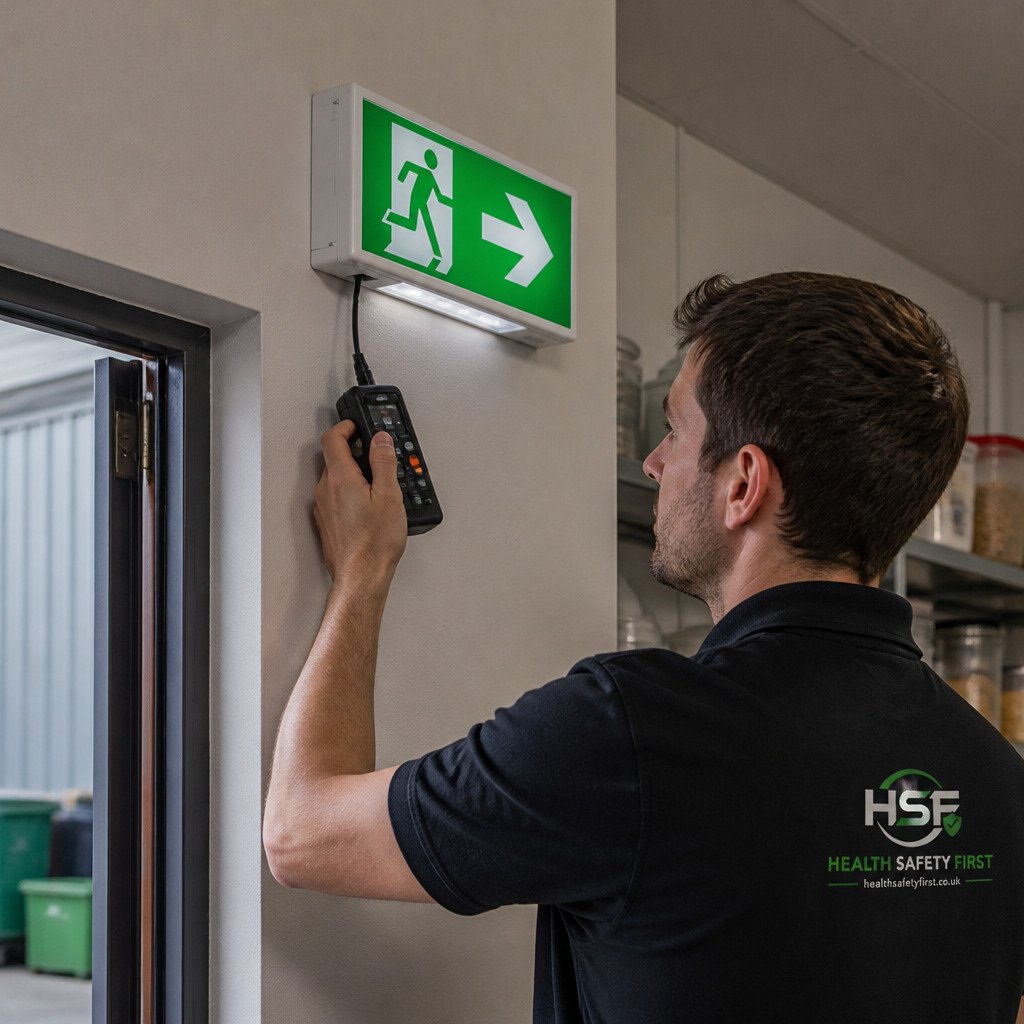
Table of Contents
- Why Emergency Lighting Testing Matters for UK Premises
- How Often Emergency Lighting Should Be Tested
- How to Carry Out the Emergency Lighting Monthly Test
- Planning the Annual Emergency Lighting Duration Test
- Keeping an Emergency Lighting Test Log Book
- Who Can Carry Out Emergency Lighting Testing
- What to Do When an Emergency Light Fails a Test
- Setting Up Your Emergency Lighting Testing Schedule
- Frequently Asked Questions
Last Updated: November 1, 2026
Emergency lighting is the last line of defence when the power fails during an evacuation, and it only works if it is tested regularly, so knowing how often to test emergency lighting in the UK is a core part of compliance for every owner. For owners of independent cafés and restaurants, knowing how often to test emergency lighting in the UK is a core part of fire safety compliance. This guide explains the testing schedule, the steps to follow, the records to keep and what to do when a light fails.
Why Emergency Lighting Testing Matters for UK Premises
Emergency lighting guides people safely out of a building when mains power is lost. A light that has failed silently can leave staff and customers in the dark at the moment they most need to see the exits.
Testing is how you find those faults before an emergency does. A regular programme of checks shows that each luminaire lights, that its battery holds charge and that the exit routes stay clearly lit.
Guidance on emergency lighting in the UK is set out in BS 5266, the code of practice for emergency lighting, and in the Regulatory Reform (Fire Safety) Order 2005 for non-domestic premises. You can read the official text on legislation.gov.uk Regulatory Reform (Fire Safety) Order 2005.
How Often Emergency Lighting Should Be Tested
Most premises follow a two-part pattern when deciding how often to test emergency lighting in the UK. A short functional test runs once a month, and a longer full-duration test runs once a year.
- Monthly: a short functional test to confirm each light switches on.
- Annually: a full-duration test that runs the lights until the battery is drained.
Many businesses also carry out simple visual checks each day or week. These are quick looks to confirm that lights are not blocked, damaged or obscured.
Keep in mind that the duration test should follow the manufacturer's instructions and the guidance in BS 5266. Check the official standard for the exact rules that apply to your building.
The article sets out the two-part testing pattern that most premises follow.
| Test | Frequency | What it checks |
|---|---|---|
| Visual check | Each day or week | Lights unblocked, undamaged and unobscured |
| Functional test | Monthly | Each light switches on |
| Full-duration test | Annually | Battery holds charge for the full period |
How to Carry Out the Emergency Lighting Monthly Test
The monthly test is quick and simple. Follow these steps:
- Tell staff the test is starting so no one is alarmed by the lights going out.
- Press the test switch or use the test key on each luminaire, or run the automatic test system if you have one.
- Check that each light comes on and stays lit for a few minutes.
- Look for lights that flicker, dim or fail to switch on.
- Reset the lights to normal mode and record the results.
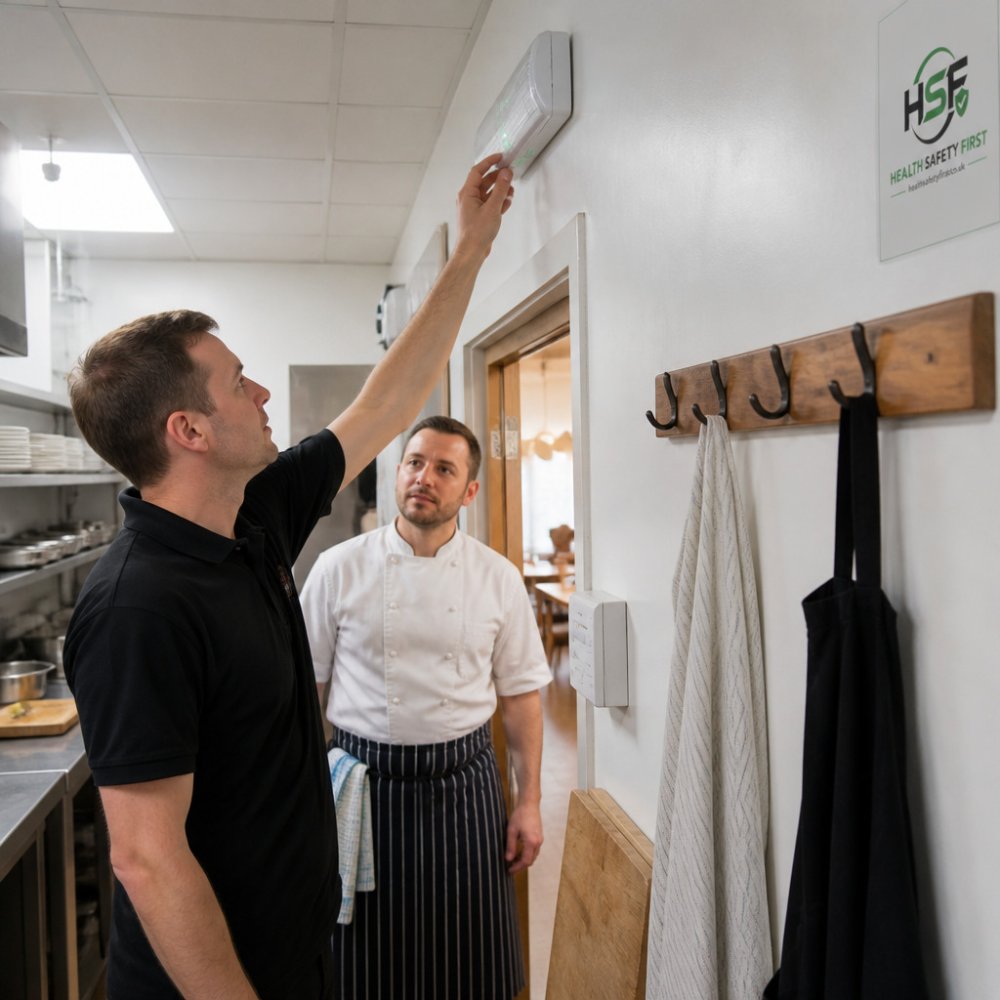
A member of staff can carry out the test in a café kitchen corridor by pressing the test switch on a wall-mounted light while a colleague watches nearby.
Watch out: a light that switches on during the monthly test may still have a weak battery. Only the full-duration test shows whether the battery can keep it lit for long enough.
Planning the Annual Emergency Lighting Duration Test
The annual duration test checks the battery. It runs each light until the battery is drained to confirm it can keep the exits lit for the full period.
Plan the test for a quiet period, such as early in the morning or on a closed day, because the lights stay on the whole time. Warn staff and check that any alternative lighting or signs are in place.
After the test, the batteries need time to recharge fully. Check the manufacturer's guidance for the recharge period before the premises reopen.
Keeping an Emergency Lighting Test Log Book
A log book is your proof that testing has taken place. It helps you show an inspector, insurer or fire authority that the system is maintained.
Record the following for each test:
- The date and time of the test
- The name of the person who carried out the test
- The type of test: monthly functional or annual duration
- Each light tested, and whether it passed or failed
- Any faults found and the action taken
- The date of the next test
Store the log book where it is easy to find and keep older entries for reference.
Who Can Carry Out Emergency Lighting Testing
The responsible person for fire safety is usually the employer, owner or manager. They can carry out the tests themselves or appoint someone else to do it.
Choose someone who is trained and competent to test emergency lighting safely. Trained staff can carry out the monthly checks, while the annual duration test is often better left to a specialist contractor.
Under the Management of Health and Safety at Work Regulations 1999, employers must appoint competent people to help meet their duties. You can read more at HSE guidance on fire safety responsibilities.
What to Do When an Emergency Light Fails a Test
A failed light is a fault that needs fixing quickly, but the response should be systematic. The aim is to record the fault, keep the escape route safe in the meantime and confirm the repair with a retest.
Step-by-step response to a failure
- Make it safe and visible. Mark the faulty luminaire clearly, note its location and record the fault in the log book with the date and time.
- Check the simple causes first. Look for a blown fuse, a loose connection, a dirty lens, a discharged battery or a fault indicator on the fitting or control panel.
- Arrange repair or replacement. Use a competent person, either a trained member of staff for basic checks or a specialist contractor for battery replacement, wiring faults or control-panel issues.
- Manage interim safety. While the light is out of service, confirm the escape route is still adequately lit. This may mean temporary portable lighting, additional signage or restricting the use of an area until the repair is complete.
- Retest after repair. Once fixed, run a functional test on the repaired light and record the result. For a battery replacement, a full-duration test may be needed to confirm the new battery holds charge.
- Update the log and review the pattern. Record the corrective action and the retest result. If the same type of fault keeps recurring, review whether the equipment is due for replacement or whether the testing regime needs adjusting.
Recording faults and corrective actions
For each failure, record:
- The date and time the fault was found
- The location and identifier of the luminaire
- The nature of the fault
- The interim measure put in place, if any
- The repair or replacement carried out
- The date of the retest and the result
When to escalate
Escalate to a specialist contractor if the fault involves the central battery unit, repeated battery failures across multiple fittings, wiring or circuit problems, or any issue you cannot resolve with basic checks. Keep a record of the contractor's details and the work carried out.
Setting Up Your Emergency Lighting Testing Schedule
A written schedule turns the monthly and annual requirements into something staff can actually follow. Build it around the testing cycle, assign named people to each task and keep it where the person doing the test can see it.
A practical twelve-month calendar
Use a simple wall planner or shared calendar with these recurring entries:
- Every month: functional test of every luminaire, with results logged the same day.
- Every week (or daily in busy premises): a quick visual check that lights are unobstructed, undamaged and showing a healthy charge indicator.
- Once a year: full-duration test, planned for a quiet period and booked in advance.
- After any fault: retest the repaired light and update the log.
- Each year: review the log book and check the system against the current edition of BS 5266 and your fire risk assessment.
A usable monthly checklist
A short checklist keeps the functional test consistent from one month to the next:
- Confirm the date and time, and tell staff the test is starting.
- Activate each luminaire using its test switch or key, or trigger the automatic test system.
- Confirm every light illuminates and stays lit for the required few minutes.
- Note any light that flickers, dims, fails to start or shows a fault indicator.
- Reset the system to normal mode.
- Record the result for each light and sign the log.
Adapting the schedule to your system type
The practical arrangements vary with the equipment installed:
- Self-contained luminaires: each fitting has its own battery and test switch, so the monthly test is done fitting by fitting. This is common in small cafés and restaurants.
- Central battery systems: a single control unit serves multiple lights. Testing is usually done from the control panel, and faults are traced back to the central unit or the individual circuit.
- Automatic test systems: the system runs its own functional and duration tests and logs the results. Staff still need to review the log regularly and act on any faults the system reports.
Shared buildings and HMOs
In shared buildings, the responsibility for emergency lighting in common areas usually sits with the landlord or managing agent, while individual occupiers may be responsible for their own demise. Agree in writing who tests what, and make sure the log book covers the whole building rather than just one unit.
You can write your own health and safety procedures to formalise who does each task and when.
Frequently Asked Questions
How often should emergency lighting be tested in the UK?
Emergency lighting should be given a short functional test monthly to confirm each luminaire illuminates, and a full-duration test once a year. The full-duration test discharges the batteries and checks they sustain the lighting for the required period before recharging. Results should be recorded in a logbook kept on site. Current guidance is set out in BS 5266-1, and the responsible person should follow it to demonstrate reasonable fire safety management.
Who can carry out emergency lighting testing?
The responsible person for the premises can carry out routine testing, provided they are trained and competent to do so. Many businesses use a competent electrician or a specialist fire safety contractor for the annual full-duration test, particularly where the system is complex or contains central battery equipment. Whoever tests the system should understand the manufacturer's instructions, know how to isolate and restore the supply safely, and record every test accurately.
What should be recorded in an emergency lighting test log book?
Record the date of each monthly and annual test, the name of the person who carried out the test, and whether each luminaire passed or failed. Note any faults found, the action taken, and the date of repair or retest. Keep the logbook on site and make it available to fire safety inspectors on request.
What should I do if an emergency light fails a test?
Log the failure immediately, label the faulty unit so staff know it is not working, and arrange repair or replacement as soon as possible. Check whether the fault is isolated to one luminaire or affects a wider circuit or battery. Retest the unit after repair and record the outcome. Where a fault could leave escape routes poorly lit, consider restricting use of the affected area until it is fixed, and keep a record of the steps taken.
For help with fire safety for your café or restaurant, contact UK Health, Safety & Fire Guide to find out which resources suit your premises.
